

Breaking Into the Boys’ Club series | Part 6. In the previous post, Why Women Struggle to Be Heard in Executive Meetings, I explored how women who consistently get heard in high-stakes rooms aren’t louder or more aggressive — they’re more strategically positioned. In this installment, I go deeper: naming the specific traps, sharing what I’ve seen work, and offering a reframe that I believe is more useful than trying to solve for everyone’s expectations.
Several years ago, I was working with a client — a managing director with a track record most executives would envy — when she described a moment I’ve heard echoed by hundreds of women since. She’d presented a clear, decisive recommendation to her leadership team. Strong data. Confident delivery. The room went quiet for a beat, and then the conversation moved on as if she hadn’t spoken. Ten minutes later, a male colleague offered a version of the same recommendation. The room responded immediately. Agreement. Momentum. Momentum she had started.
She came to me asking: “What am I doing wrong?”
The honest answer was: nothing. She was navigating what I’ve come to think of as the central paradox of executive life for senior women. To be taken seriously as a leader, you must project authority, decisiveness, and confidence — qualities that have historically been coded as masculine. But when women display exactly those qualities, they are frequently penalized for it.
Be too assertive: you’re difficult. Not assertive enough: you’re a pushover. Be direct: you’re aggressive. Soften your delivery: you’re weak. Be strategic and confident: you’re threatening. Be collaborative and inclusive: you’re indecisive. This is the double bind. And it is not a theoretical construct — it is something I watch senior women navigate every single day.
I want to be direct: this standard is not fair. But understanding the rules of an unfair game is still a powerful position you can occupy while developing personal strategies to overcome it.
What I See in My Coaching Work
The self-doubt I encounter in coaching isn’t random — it’s the accumulated weight of navigating this bind, year after year. More than 60 percent of the senior executive women we surveyed believed men were better at promoting themselves — and felt less confident in their own professional abilities even when their skills were equal to or better than their male colleagues.
This is not a coincidence. The double bind creates a no-win environment in which the very behaviors required for advancement become liabilities when displayed by women. The result is a kind of strategic paralysis: women learn to second-guess their instincts, over-moderate every response, and carry a cognitive load their male counterparts simply don’t bear.
I want to name the specific traps I see most often — because naming them is the first step to navigating them.
The Traps I See Most Often
The Apology Trap
Women are socialized to soften communication with apologies — “I’m sorry to interrupt,” “Sorry if this is a dumb question,” “Sorry, but I disagree.” In social contexts, this is courtesy. In executive contexts, it reads as insecurity. Every unnecessary apology chips away at your authority. I tell the women I coach: men don’t apologize in boardrooms, and neither should you.
Leadership Reminder: If you’ve made a mistake, say “My data was faulty — here are the correct numbers.” If you don’t have the information, say, “I will get back to you on that.” If you arrive late, grab a seat and join the discussion. Leadership does not begin with “sorry.”
The Emotion Trap
Women who express frustration, disappointment, or passion in executive settings are routinely labeled emotional — a label that functions as a professional disqualifier. Men who display the same intensity are described as passionate or committed. I’ve seen these labels used in meetings I’ve been in and in hundreds of client stories. The trap is not that emotion must be suppressed — it’s that emotion must be channeled deliberately. Controlled passion, principled directness, and strategic vulnerability are all legitimate leadership tools. The goal is to deploy them, not suppress them.
The Likability Trap
Research consistently shows that as women become more powerful, they are perceived as less likable — while the opposite is true for men. For senior women, this creates a painful calculus: every act of authority potentially costs social capital. My counsel is always the same: stop chasing likability. Chase trust instead. Trust is built through consistent behavior over time, and it is a far more durable foundation for leadership than likability ever was.
The Collaboration Misread
Women’s tendency toward inclusive decision-making — asking questions, seeking input, building consensus — is a genuine leadership strength. I believe this deeply. But in executive meetings, the same behavior can be misread as evasion or passivity. The key is to distinguish between inclusive process and weak positioning. State your position first. Then invite challenge: “My recommendation is X. I want to hear if anyone has a compelling reason to go a different direction.”
Finding the Strategic Middle Ground
The goal is not to become someone else. It is to expand your range — to move fluidly between leadership and communication styles depending on what the situation demands, without losing your core leadership identity. Here is what I’ve seen work in practice:
- Own your expertise explicitly. Don’t hint at your qualifications — state them. Not arrogance, but clarity. “I’ve managed this type of transition three times. Here’s what I’ve learned…”
- Develop a conflict style. Women who consistently avoid conflict are perceived as weak. I am not advocating for aggression. I am advocating for managed directness — deal with issues head-on, briefly, without personal escalation.
- Push back strategically. When you get a no, don’t accept it as final. Ask for the reasoning. “Help me understand what would need to change for this to be feasible.” This is not combative — it is leadership.
- Use humor deliberately. Banter and humor are the currency of belonging in many executive environments. Women who participate in good-natured, non-offensive humor — even on the receiving end — signal that they are part of the team.
- Build your confidence foundation. The double bind is easier to navigate from a foundation of genuine self-confidence. This is built through ongoing recognition of your own track record — not from waiting for external validation.
A Different Frame
The most powerful reframe I offer for the double bind is this: the goal is not to please everyone in the room. The goal is to lead effectively. And leadership requires, at times, disappointing some people. It requires holding positions under pressure. It requires being willing to be seen as difficult by those who would prefer you to be compliant.
The women who navigate this most successfully are not the ones who found a perfect formula. They are the ones who know themselves clearly enough to make deliberate choices — about which trade-offs they are willing to make, and which they are not.
The Role of Executive Coaching
The double bind is one of the areas where working with an executive coach delivers the most direct, measurable value — because it requires both honest external feedback and an internal shift. I work with senior women to identify which specific behaviors may be triggering negative reactions in their organizations, which assets are being underutilized, and how they can strategically promote themselves and their capabilities.
I’ve seen what changes when senior women stop second-guessing themselves and start leading with intention. If you’re ready to do that work, let’s talk.
Breaking Into the Boys’ Club | Part 7: Strategic Communication in Male‑Dominated Organizations. Senior women in male-dominated organizations face a unique communication challenge: how to operate effectively within existing cultural norms without erasing their own leadership voice. In Part 7, I share the four most important communication adjustments I’ve seen work in practice, along with specific protocols for executive meetings and guidance on navigating conflict with authority.
About This Series
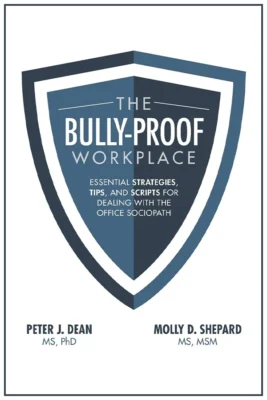
The Bully-Proof Workplace
We wrote The Bully-Proof Workplace because, after more than three decades coaching CEOs, boards, and senior executives, we kept seeing the same crisis play out in corner offices, boardrooms, and leadership teams: workplace bullying was eroding culture, destroying talent, and quietly devastating bottom lines — while leaders either looked away or had no tools to act.
Each post addresses a specific facet of workplace bullying — from recognizing the four types of bullies to knowing when to escalate, how to coach a manager who has a bully on their team, and how to build a policy that actually sticks. This is not theoretical. These are the tools we have used with clients for 30 years.