

The Bully-Proof Workplace series | Part 3. In Part 2 — Confronting Workplace Bullying: A Strategic Imperative for Senior Leaders — we examined how workplace bullying affects nearly 75 million American workers and costs organizations hundreds of billions of dollars annually. We lay out why senior leaders can no longer afford to look away — and what a visible, strategic response looks like. This week, we’ll examine how the financial toll of workplace bullying is staggering — from productivity losses and turnover to legal exposure and reputational damage. We break down the full cost picture that every C-suite leader needs to understand.
What Workplace Bullying Is Actually Costing Your Organization
As we noted in Confronting Workplace Bullying: A Strategic Imperative for Senior Leaders, a bullying culture fuels turnover, erodes trust, and deters the diversity of thought that drives innovation. It can cost the company dearly in lost talent, diminished engagement, absenteeism, and even litigation. The human toll is equally serious: stress-related illness, depression, and damaged professional confidence that can take years to rebuild.
In our more than three decades as executive coaches, we have seen this play out in boardrooms, corner offices, and leadership teams across industries — financial services, healthcare, pharmaceuticals, technology, law, government, and nonprofits. The costs accumulate quietly, and by the time most senior leaders recognize what is happening, the damage to culture, performance, and reputation is already significant.
The Financial Toll Is Larger Than Most Leaders Realize
The most immediately visible cost of workplace bullying is employee turnover — and it is a significant one. Replacing a high-performing employee can cost two to three times that person’s annual salary when you account for recruiting, onboarding, lost institutional knowledge, and the time it takes for a replacement to become fully productive. Bullied employees, and those who witness bullying, disengage and eventually leave. Your best people — those with the most options — are often the first to go.
Absenteeism compounds the problem. Employees experiencing bullying report significantly higher rates of stress-related illness and mental health strain, and they take more sick days as a result. Research from the Society for Human Resource Management found that decreased morale was reported by 68 percent of organizations that experienced bullying incidents, increased stress and depression by 48 percent, and decreased trust among coworkers by 45 percent. These are not soft metrics. They translate directly into reduced productivity, weaker collaboration, and measurable drops in output quality.
Then there is the legal exposure. Organizations that tolerate bullying face increasing risk of litigation — from harassment claims to hostile work environment suits — and the costs of defending those claims, even when companies prevail, are substantial. The reputational damage that follows public legal proceedings can undermine recruiting, client relationships, and shareholder confidence for years.
The Costs You Cannot Put a Number On
Some of the most damaging consequences of workplace bullying are the hardest to quantify — but they are no less real, and no less urgent for senior leaders to understand.
We have found in our coaching practice that bullies often target precisely those employees who challenge the status quo: the ones willing to suggest ideas outside the boundaries of conventional thinking, to ask difficult questions, or to push back on decisions they believe are wrong. When those employees are bullied into silence — or out of the organization entirely — the organization loses something it may not even know it had. The culture becomes more insular, more risk-averse, and less capable of the creative problem-solving that drives competitive advantage.
Psychological safety disappears. When employees cannot trust that speaking up will be met with respect rather than retaliation, they stop contributing fully. Meetings become performative. Feedback loops break down. The candid dialogue that good organizations depend on to catch problems early and course-correct is replaced by silence, politeness, or managed appearances. We have seen this pattern at every level of the organizations we work with, and it is consistently one of the most difficult things to rebuild once trust has been broken.
Beyond the office walls, the damage extends into employees’ personal lives. Bullying is not something people leave at work. The stress, anxiety, and diminished confidence it produces travel home, affecting families and relationships in ways that create a vicious cycle — one that is increasingly recognized in research on burnout, mental health, and family dynamics.
When Leaders Look Away, the Culture Pays the Price
The data from the Workplace Bullying Institute is striking: more than 56 percent of employers either deny that bullying exists, discount its effects, or rationalize the behavior. Only 16 percent of employers acknowledge and condemn it, and just 12 percent actively work to eliminate it. In our experience, this is not malice — it is most often a combination of discomfort with conflict, misplaced loyalty to high performers whose behavior is destructive, and a lack of tools to intervene effectively.
But the cost of inaction is real and measurable. What thrives in an organization where bullying is tolerated is not performance — it is depression, anxiety, customer complaints, and litigation. The quality of work declines. Productivity suffers. Employee loyalty and engagement erode. And if the behavior is left unchecked, the damage eventually registers in the organization’s bottom line in ways that are impossible to ignore.
We know from experience that bullies and bully bosses stall, rather than accelerate, productivity and engagement. They impede the growth of talent. They make organizations more fragile, not more competitive. The leader who believes a high-performing bully is an asset to the team is, in most cases, wrong — and the longer they hold that belief, the more it will cost.
Addressing Bullying Is a Leadership Responsibility
Creating a zero-tolerance policy for bullying and empowering managers to use their authority constructively leads to measurably better results: higher engagement, greater innovation, stronger retention, and a culture that attracts the kind of talent organizations need to thrive in a competitive environment. An emotionally connected, interpersonally engaged workforce is more productive — and that translates directly into higher profits.
Senior executives cannot afford to treat the costs of bullying as someone else’s problem. This is not an HR matter that can be delegated and forgotten. It is a leadership responsibility, and the organizations that take it seriously are the ones that build cultures where people stay, grow, and perform at their best.
Equip your leadership team with the strategies needed to eliminate workplace bullying and build a thriving, high-performing culture. Contact us for a confidential conversation.
The Bully-Proof Workplace series | Part 4. In the next chapter, The Four Types of Workplace Bullying, we explore how not all bullies behave the same way. We introduce the four types we’ve identified through decades of coaching: the Belier, the Blocker, the Braggart, and the Brute – and explain why knowing the difference changes everything about how you respond.
About This Series
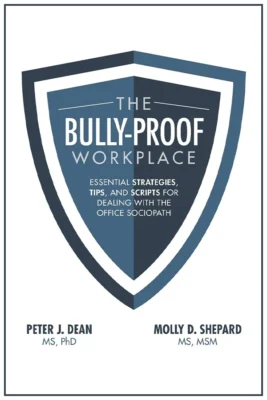
The Bully-Proof Workplace
We wrote The Bully-Proof Workplace because, after more than three decades coaching CEOs, boards, and senior executives, we kept seeing the same crisis play out in corner offices, boardrooms, and leadership teams: workplace bullying was eroding culture, destroying talent, and quietly devastating bottom lines — while leaders either looked away or had no tools to act.
Each post addresses a specific facet of workplace bullying — from recognizing the four types of bullies to knowing when to escalate, how to coach a manager who has a bully on their team, and how to build a policy that actually sticks. This is not theoretical. These are the tools we have used with clients for 30 years.